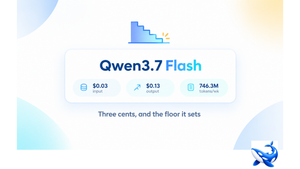
Qwen3.7 Flash: The Three-Cents Floor of Qwen’s Price Ladder
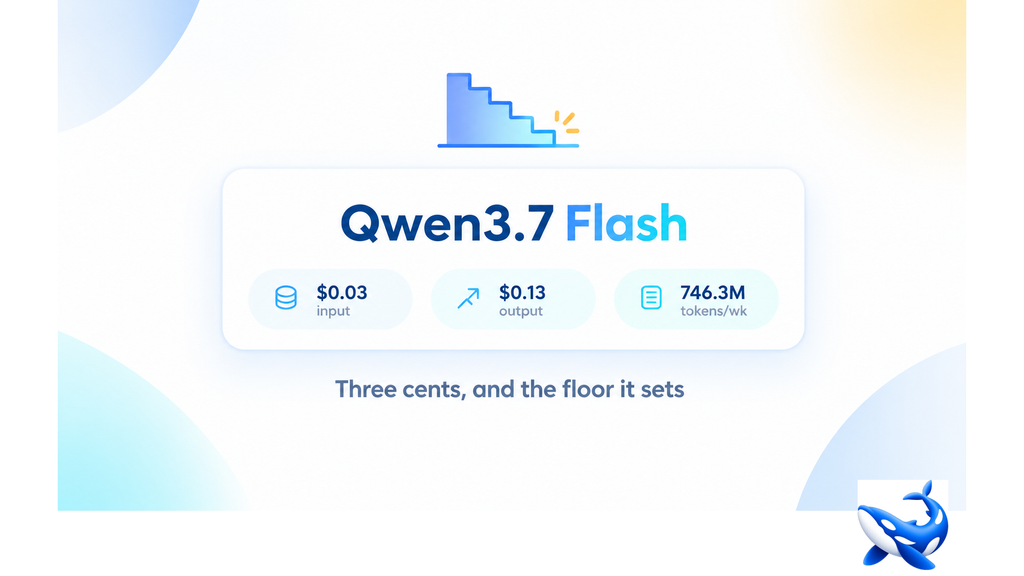
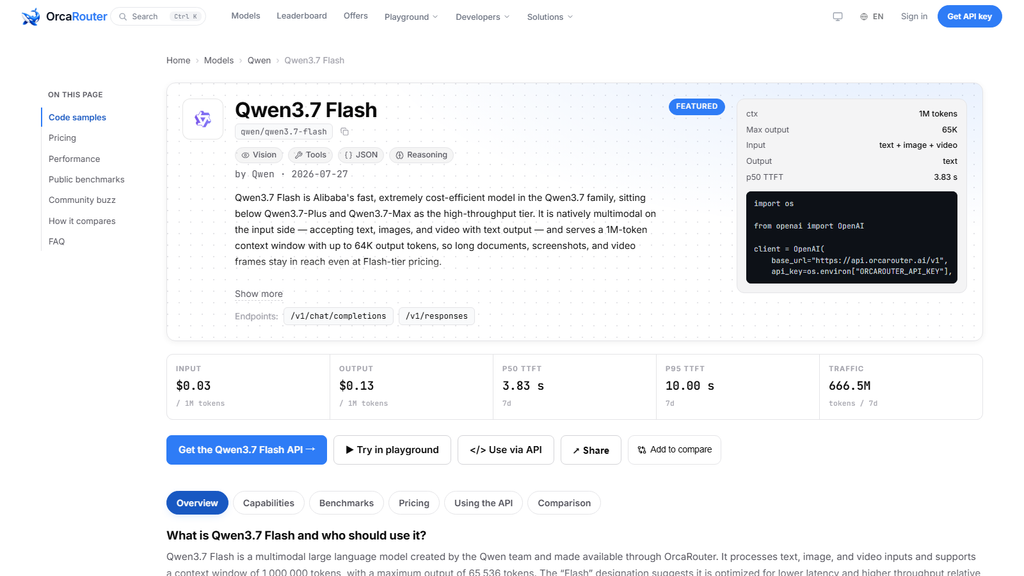
On OrcaRouter we host the Qwen3.7 Flash model — the entry rung of Qwen’s previous-generation family, shipped on July 27, 2026, priced at $0.03 per million input tokens and $0.13 per million output, with a 1M-token context window and a 64K maximum output. That input price is the lowest of any text model in this fleet — the floor of Qwen’s own price ladder. It has no page on Artificial Analysis, the independent benchmark site that covers the rungs above it. In production its p50 time-to-first-token is 3.83 seconds. It is carried at list price on the same key as every other Qwen model, with the live telemetry on the linked page.
Three cents per million input tokens is not a discount — it is a different pricing philosophy, and this article is about what a card that cheap can and cannot be.
What three cents a million means
The number deserves its own arithmetic. At $0.03 per million input tokens, a million-token document — a large corpus, a long transcript, a year of a team’s chat history — costs three cents to push through the model, and the 746.3 million tokens it moves every week in production shows the market already treats it as a bulk commodity. This is the price band where the input cost of a workload stops being something anyone models; it becomes a rounding error on the electricity the pipeline itself burns.
The frame changes with it. A card at this price is not bought for its ceiling — the absence of a page on Artificial Analysis leaves the quality question formally open — it is bought because the per-token cost makes every volume experiment affordable. Teams can run sweeps, batch every document they own, and throw away the outputs they do not need. Three cents per million is the price at which a failed experiment costs nothing to have tried.
The Qwen ladder, priced
| model | release | context | input / output | AA index | 7-day tokens | p50 TTFT |
| Qwen3.8 Max (0902) | 2026-09-02 | 1M (AA: 984K) | $2 / $6 | 45 | 64.4M | 3.12 s |
| Qwen3.8 Flash | 2026-08-26 | 1M | $0.15 / $0.47 | no page on AA | 836.1M | 8.40 s |
| Qwen3.7 Plus | 2026-06-01 | 1M | $0.35 / $1.42 | 25 | 20.1M | 2.98 s |
| Qwen3.7 Flash | 2026-07-27 | 1M | $0.03 / $0.13 | no page on AA | 746.3M | 3.83 s |
Release dates, context windows and rate cards are what Qwen lists; the two independent readings in the table belong to the Max and Plus rungs; the token volumes and TTFT figures are production telemetry from the linked pages. Read the ladder top to bottom and the story writes itself: the generation above charges sixty-seven times more for the same advertised context, and the market splits its volume across the rungs by work — 836.1M on the new Flash, 746.3M on the old Flash, single-digit millions on the premium cards. The three-cents rung is the floor the whole ladder is built on.
The bulk-token profile
The production record on the linked page is the profile of a bulk card: 746.3 million tokens a week at a 3.83-second first token. The latency is the most reasonable of the Flash rungs — materially faster than the current generation’s 8.40 seconds — which is worth saying because it inverts the usual trade: the cheapest card here is also the more responsive one. For volume work, that combination — near-free input, tolerable latency, a full megabyte of context — is precisely the shape a batch pipeline wants.
The honest caveat is the empty scorecard column. Without an independent index reading, the article can stand behind the vendor’s price and context and behind our telemetry, and nothing more. What the market’s 746.3 million weekly tokens add is the practical answer: at this price, the quality bar for volume work is “good enough, and if not, throw it away and rerun” — and three cents per million makes even that iteration effectively free.
There is a subtlety worth naming in that 746.3 million: it is a previous-generation card outselling its own successor. The new Flash rung charges five times as much per input token and sits at 836.1 million — close, but not the blowout a successor usually expects — which reads as the market keeping a large share of volume on the floor while the price ladder below it stayed intact. It is the rare case where the cheapest option is also the incumbent, and the 64K output ceiling is the only structural thing the three-cent card gives up. A team that needs bulk input at near-zero cost and does not need long generations is buying almost nothing but the price — and the price is the floor.
Where the floor fits
The disciplined way to use a floor card is to keep it where the floor belongs. Long-context ingestion, bulk extraction, deduplication sweeps, first-pass drafts that a stronger card will rewrite, data-prep passes over everything a team owns: these are the workloads where the three-cent input price compounds across millions of tokens and the output quality only needs to be competent. Teams that feed this rung their volume and keep the premium rungs for what needs a ceiling get the ladder’s arithmetic right.
The misuse is the same as any floor: expecting the floor to be the ceiling. A card this cheap, with no independent score and a previous-generation nameplate, is not the tool for the workload that justifies the premium rungs — and the market’s own split says it knows, keeping this card’s volume in the hundreds of millions while the premium cards run single-digit millions. Keep the floor on the floor, and the whole ladder works.
The takeaway
Qwen3.7 Flash is the entry rung of Qwen’s previous generation: $0.03 / $0.13, a 1M context window, a 64K maximum output, and a 3.83-second p50 first token on our production record — the most responsive of the Flash rungs. Its 746.3 million weekly tokens make it one of the most-called cards in the fleet, bought at the lowest input price of any text model we serve. It has no page on Artificial Analysis, so no independent score is cited here. If a workload is volume-shaped and input-heavy, this is the card that makes the corpus-wide sweep cost three cents a million — live at list price, with the telemetry on the linked page.